

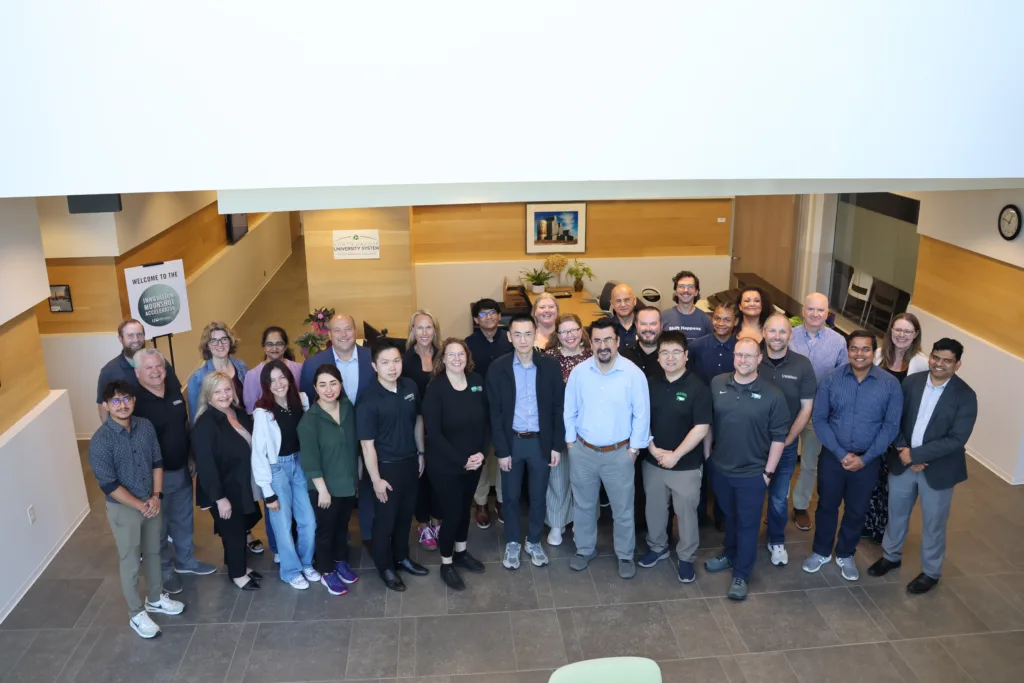
This summer, the University of North Dakota Center for Innovation embraced a challenge inspired by President Armacost’s Innovation Moonshot initiative: spark innovation across every corner of campus and launch four companies based on university research in a single year. It is an ambitious goal, but it also creates an opportunity to reflect on what truly drives successful university commercialization.
After working with ten faculty-led teams this summer from disciplines spanning healthcare, aviation, music, artificial intelligence, energy, and advanced manufacturing, one lesson stood above the rest: university commercialization must begin with curiosity.
Faculty researchers are naturally curious people; it is the focal point of their discoveries. Curiosity inspires new questions and advances knowledge. That same curiosity can also be a powerful driver for researchers interested in commercialization because it helps them explore how their work creates value beyond the laboratory.
The Moonshot Summer Accelerator was grounded in the tenets of customer discovery. This means we acknowledge the researchers as experts in their technology, but not experts in the daily challenges, purchasing decisions, and operational realities of potential customers. Customer discovery creates a structured process for learning from others by testing assumptions and understanding whether a solution addresses a meaningful problem.

Recently, while reading a book on leadership and coaching, I came across a story that perfectly captures the mindset and challenges of customer discovery and university commercialization. In the story, a professor visits a Zen master to learn about Zen Buddhism.
The master begins pouring tea into the professor’s cup and continues pouring until it overflows. The professor protests, pointing out that the cup is already full and the Zen Master should stop pouring tea. The Zen master calmly responds, “How can I add anything when your cup is already full?”[1] The story illustrates a powerful lesson that we can use to describe the importance and power of customer discovery to faculty interested in commercializing their research. Growth requires us to set aside what we think we know so we can discover something new. This principle applies to university commercialization.
Researchers build their solution convinced they already know who needs their solution, and what value it provides. Our experience tells us something different. We know that some of the most important insights emerge when researchers step back and listen to potential customers. Customer interviews often reveal unexpected challenges, alternative applications, overlooked adoption barriers, or entirely new market opportunities.

At the Center for Innovation, our role is not to tell faculty what to build, to challenge their expertise, or the years they have invested in their research. Instead, our role focuses on providing the tools, mentors, and guidance for them to become students again by approaching commercialization with the mindset of an “empty cup.”
When researchers are open to learning, customer discovery is more than a commercialization exercise. It becomes a tool to reduce risk, refine technology development priorities, and identify the most promising path to impact. Sometimes the result is validation and a clearer route to market. Sometimes it reveals a need to pivot. Occasionally, it demonstrates that a market opportunity may not justify further investment. All these outcomes represent success because they are grounded in learning. This summer reminded me that the first question we should ask faculty interested in commercializing their research is whether they are willing to approach the journey as an empty cup, ready to make room for someone else to pour in the tea.
[1] Source: Lynch, J. (2013). Coaching with Heart: Taoist Wisdom to Inspire, Empower, and Lead in Sports and Life. Tuttle Publishing.